Governance Bodies
Oji Holdings has established the Fundamental Policies on Corporate Governance, which set out the basic concepts, framework, and operational policies concerning corporate governance. The Board of Directors is responsible for developing sustainability-related risk management systems and supervising their operational status, while effectively supervising Executive Directors and Corporate Officers from an independent and objective standpoint.
To promote the sustainable growth of the Oji Group and enhance its corporate value over the medium to long term, the Board of Directors is composed with due consideration given to a balance of diverse knowledge and expertise concerning the businesses operated by the Group. The Board includes members with skills and expertise in sustainability and ESG matters.
Directors endeavor to acquire the knowledge necessary to fulfill their respective roles and responsibilities. They receive training on sustainability-related regulatory developments and other relevant matters both upon assuming office and during their terms of office. In addition, as a general rule, important matters concerning the Group’s business execution are reported twice a month to Outside Officers, comprising Outside Directors and Outside Audit & Supervisory Board Members, in order to strengthen their supervisory functions.
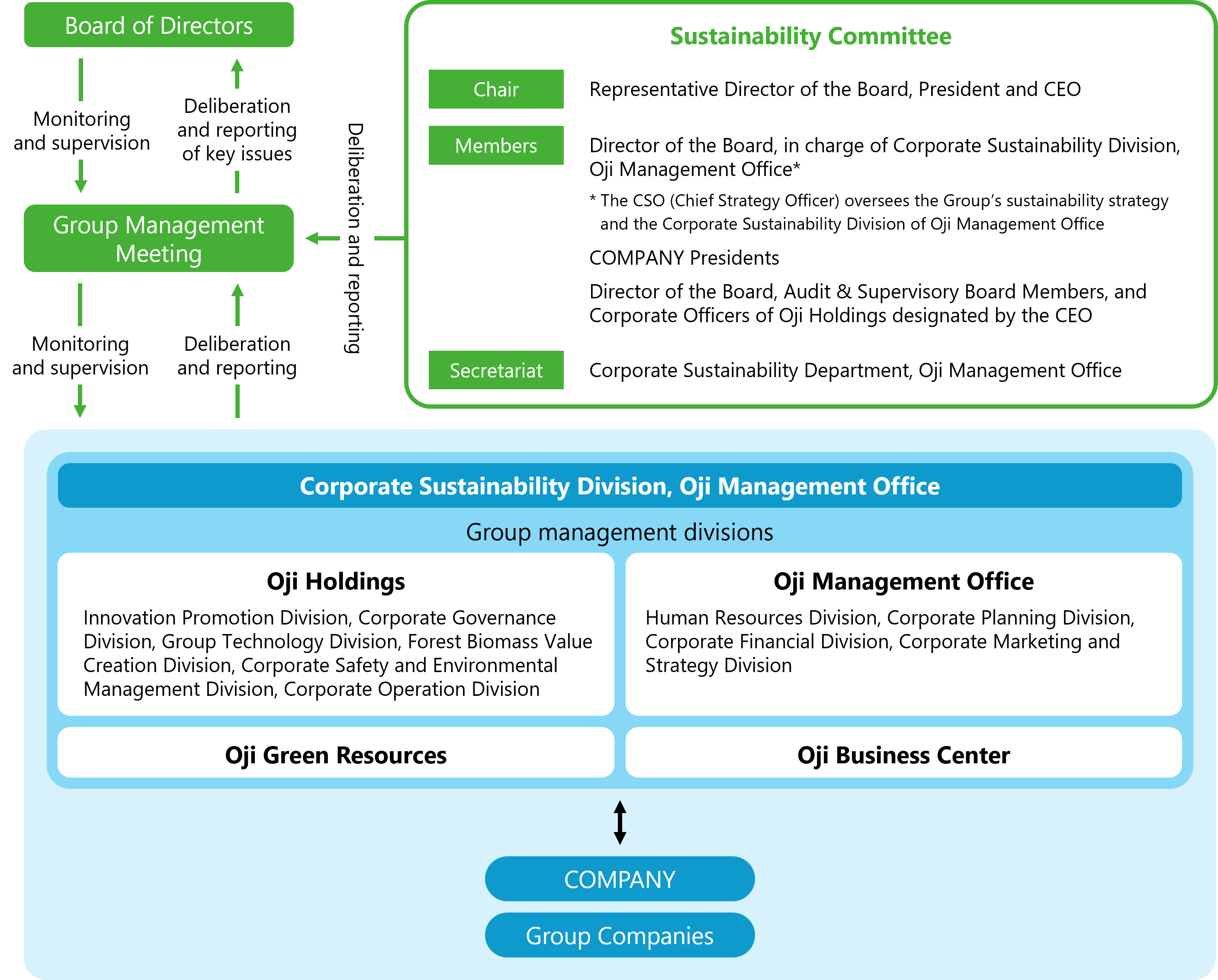
In addition, pursuant to the relevant Group Regulations, the Sustainability Committee meets twice a year under the supervision of the Board of Directors to discuss the Group’s sustainability-related risks and opportunities and measures to address them, and to promote Group-wide initiatives. The Committee is chaired by the Representative Director of the Board, President and CEO of Oji Holdings and comprises the Corporate Officer in charge of the Corporate Sustainability Division of Oji Management Office, COMPANY Presidents, and Directors, including Outside Directors, Audit & Supervisory Board Members, and Corporate Officers designated by the CEO.
Compensation for Directors, excluding Outside Directors, comprises base compensation, which is fixed compensation, bonuses reflecting short-term performance, and stock-based compensation reflecting the medium- to long-term enhancement of corporate value. Sustainability-related performance metrics are included among the evaluation criteria. The standard compensation composition is 45% base compensation, 27.5% bonuses, and 27.5% stock-based compensation.
Of these components, 10% of bonuses is linked to the lost time injury frequency rate, while 10% of stock-based compensation is linked to the promotion of nature-positive management and another 10% to employee engagement. Although the promotion of nature-positive management could consequently affect climate-related performance, climate-related performance is not used as a separate performance metric in determining Director compensation. Accordingly, 8.25% of total Director compensation is linked to ESG-related evaluation items.
Management’s Role
At the Oji Group, under the oversight of the Chief Strategy Officer (CSO), who is a Corporate Officer, the Corporate Sustainability Division identifies sustainability-related risks and opportunities across the Group. The identified risks and opportunities, together with measures to address them, are discussed and approved by the Sustainability Committee, which is chaired by the CEO.
Significant sustainability-related risks and opportunities identified through this process are deliberated by the Group Management Meeting and shared with Group companies as part of the Group’s strategies and other important information. Among the matters deliberated by the Group Management Meeting, important matters relating to Group management strategies, including fundamental policies on sustainability, are monitored and supervised by the Board of Directors.
With respect to the execution of decisions, the Corporate Sustainability Division is responsible for overall management and coordination under the oversight of the CSO, while Group companies implement measures under the oversight of their respective COMPANY Presidents.
In implementing these measures, the Group management divisions of Oji Holdings, Oji Management Office, Oji Green Resources, and Oji Business Center provide support for planning and implementation. Each month, the Corporate Sustainability Division reports to the CSO on the status of measures taken to address sustainability-related risks and opportunities and the progress of initiatives undertaken by Group companies. Matters are submitted to the Group Management Meeting for deliberation and reporting according to their significance. Significant sustainability-related risks and opportunities are also reported to the Board of Directors as necessary, at the discretion of the CSO.
Matters Discussed by the Committee
Matters Specified in the Sustainability Committee Regulations
- Climate-related risks and opportunities and responses to them
- Nature-related dependencies, impacts, risks and opportunities in the Oji Group’s operations, responses to them and the restoration and enhancement of natural capital
- Nature-related dependencies, impacts, risks and opportunities in upstream and downstream value chains, responses to them and the restoration and enhancement of natural capital
- Establishment of a circular economy
- Sustainable forest management
- Reduction of plastic use and pollution in the Oji Group's operations and supply chain
- Water-related risks and opportunities and responses to them
- Supply chain sustainability risks and responses to them
- Environmental risks and responses to them
- Human rights risks and responses to them
- Anti-corruption measures
- Inclusion and diversity
- Other important matters related to sustainability and responses to them
Major Matters Discussed in FY2025
- Review of the process for identifying Material Issues
- Human rights training at overseas operating companies
- Visualization of the value of natural capital
- Response to EU Deforestation Regulation (EUDR)
- Response to SSBJ Sustainability Disclosure Standards
- Progress of the plan to convert coal boilers to new fuels
- Progress of the plan to expand overseas forest plantations
- Progress of efforts to achieve the water withdrawal intensity reduction target
- Progress toward the target for improving the effective utilization rate of waste materials
- Status of disaster prevention, safety management, and environmental management initiatives