- Policy
- Structure
- Water Risk Assessment (Identification of Areas of High Water Stress)
- Targets and Achievements
- Prevention and Mitigation of Negative Impacts in Areas of High Water Stress
- Group-wide Initiatives to Reduce Water Withdrawal and to Make Effective Use of Water
- Group-wide Approach to Water Management
- Examples of Water Reduction Initiatives
- Examples of Effective Water Use Initiatives
- Prevention and Mitigation of Regional Impact through Wastewater Treatment
- Engaging with Water-Related Stakeholders (Outside Areas of High Water Stress)
- Data
Policy
Water is a finite resource, and the water environment varies depending on regional conditions. The Oji Group recognizes that excessive water use without regard to local conditions may cause negative impacts on the region, such as restricting access to water by other local users, and may lead to risks to business continuity through resource depletion. To prevent and mitigate such negative impacts and to reduce such risks, the Oji Group carries out appropriate water resource management through stakeholder engagement with local water managers and users.
For our suppliers, we set out our expectations regarding water resource conservation in the "Oji Group Sustainability Action Guidelines for Supply Chains", and we work to reduce water consumption throughout the supply chain.
Structure
The Representative Director of the Board, President and CEO of Oji Holdings Corporation chairs the Sustainability Committee. The committee comprises Directors, Audit & Supervisory Board Members and Corporate Officers (including the Presidents of all COMPANIES and Outside Directors). The committee is responsible for formulating policies and action plans for water resource strategy and performance, monitoring progress and evaluating achievement. Water withdrawal volume and water withdrawal intensity are incorporated into the annual plans and are regularly managed throughout the year.
Water resource initiatives across the Oji Group are managed jointly by the Corporate Sustainability Department of Oji Management Office and the Environmental Management Department of Oji Holdings. At least once a year, performance data on water withdrawal reduction targets are collected from each company, and water usage and progress toward targets are reviewed. The progress is reported once a year to the directors at the Sustainability Committee, and continuous improvements are implemented.
Water Risk Assessment (Identification of Areas of High Water Stress)
Depletion of water resources due to climate change and other factors may cause negative impacts on local communities and risks to business continuity.
Following a risk-based approach, the Oji Group focuses on "water stress" -- the water-related risk associated with the depletion of water resources -- among the water-related risks in its business operations (water stress, floods, water quality, regulations, etc.), and evaluates the degree of potential competition with other water users in the region. For the evaluation, the Group uses the Baseline Water Stress indicator of AQUEDUCT 4.0, the water risk assessment tool developed by the World Resources Institute (WRI). Regions classified as "Extremely high" or "High" in the 5-level evaluation are identified as "areas of high water stress".
As a result of the FY2025 analysis, 23 out of a total of 320 business sites of the Group were identified as being located in areas of high water stress. The water withdrawal and water consumption of these 23 sites account for less than 1% and less than 2% of the Group's total, respectively; the production volume accounts for less than 3%; and the sales revenue and assets each account for approximately 5%. On this basis, the financial impact is assessed to be limited.
At the same time, the Oji Group has identified negative impacts on local communities from water use in areas of high water stress. Through stakeholder engagement conducted at least once per year, the Group implements initiatives to reduce water withdrawal and to make effective use of water, thereby preventing and mitigating negative impacts.
Water Stress Assessment(FY2025)*1
- * This table can be viewed by scrolling horizontally.
| Number of business sites※2 | Water withdrawal (Thousands of m3) |
Wastewater (Thousands of m3) |
Water consumption※3 (Thousands of m3) |
Production volume (Thousands of tons) |
Sales Revenue (JPY 100 million) |
Assets (JPY 100 million) |
|||||||
|---|---|---|---|---|---|---|---|---|---|---|---|---|---|
|
Low(<10%)or No data |
72 | 323,356 | 48.76% | 310,936 | 48.89% | 12,420 | 45.53% | 6,506 | 44.0% | ||||
| Low to medium(10-20%) | 126 | 208,291 | 31.41% | 203,441 | 31.99% | 4,851 | 17.78% | 4,495 | 30.4% | ||||
| Medium to high(20-40%) | 99 | 129,851 | 19.58% | 120,188 | 18.90% | 9,663 | 35.42% | 3,372 | 22.8% | ||||
| High(40-80%) | 6 | 1,475 | 0.22% | 1,201 | 0.19% | 274 | 1.00% | 137 | 0.9% | 1,181※4 | 6.3% | 1,143※4 | 4.3% |
|
Extremely high (>80%) |
17 | 247 | 0.04% | 175 | 0.03% | 71 | 0.26% | 286 | 1.9% | ||||
- *1 WRI’s AQUEDUCT (4.0) Water Risk Atlas - Baseline Water Stress (5-level evaluation): Indicates the degree of potential competition with other users of water, with higher values indicating more intense competition and higher risk.
Learn more about Aqueduct - *2 Excludes main offices, sales offices, and other business sites not involved in product manufacturing.
- *3Water consumption is the amount of water intake minus the amount of water discharged.
- *4Subtotals of sales and assets of companies that have business sites located in areas of high water stress (High and Extremely High), and the ratio of each against the total sales and assets of the entire Group.
In addition, to mitigate water-related risks, the Group is currently investing approximately 30 million yen per year in the development of water treatment technology as a research theme. In the future, the mitigation of water-related risks and the development of new water-related businesses may contribute to the stability and growth of the Group as a whole.
Targets and Achievements
Target -Reduction of water withdrawal and consumption-
- Environmental Action Program 2030: Reduction of water withdrawal intensity by 6% or more by FY2030, compared to FY2018.
- Environmental Action Program 2040: Reduction of total water withdrawal by 10% or more by FY2040, compared to FY2018.
Target - Water use in areas of high water stress -
- Environmental Action Program 2040: Conducting stakeholder engagement at least once per year in areas of high water stress.
- * This table can be viewed by scrolling horizontally.
| FY2018 | FY2019 | FY2020 | FY2021 | FY2022 | FY2023 | FY2024 | FY2025 | Compared to FY2018 | |
|---|---|---|---|---|---|---|---|---|---|
|
Water withdrawal (million m3) |
740 | 737 | 706 | 714 | 710 | 695 | 687 | 663 | - |
|
Water witdrawal intensity (1,000 m3/million yen) |
0.48 | 0.49 | 0.52 | 0.49 | 0.42 | 0.41 | 0.37 | 0.36 | -25.4% |
| Waste water (million m3) | 708 | 701 | 672 | 676 | 673 | 672 | 651 | 636 | - |
| Water consumption (million m3) | 32 | 36 | 34 | 38 | 37 | 23 | 35 | 27 | - |
To mitigate risks associated with water withdrawal, the water used at plants is not just surface water from rivers and other sources, but also groundwater and water from third-party water sources (industrial water, etc.).
- * This table can be viewed by scrolling horizontally.
| FY2018 | FY2019 | FY2020 | FY2021 | FY2022 | FY2023 | FY2024 | FY2025 | |
|---|---|---|---|---|---|---|---|---|
|
Surface water (river, lake, etc.) (million m3) |
488 | 483 | 463 | 466 | 453 | 443 | 436 | 423 |
|
Surface water (sea) (million m3) |
10 | 10 | 9 | 9 | 9 | 9 | 9 | 9 |
| Groundwater (million m3) | 137 | 133 | 128 | 127 | 131 | 128 | 129 | 121 |
|
Third party organization (million m3) |
106 | 111 | 106 | 112 | 117 | 115 | 112 | 110 |
Prevention and Mitigation of Negative Impacts in Areas of High Water Stress
The Oji Group has continuously interviewed business sites located in areas of high water stress. In FY2023, the Group conducted a detailed survey of 21 business sites identified at the time as being located in areas of high water stress (Click here for the FY2023 survey results). In FY2024, the Group conducted an on-site review of the initiatives at IPI.
In the Environmental Action Program 2040, formulated in May 2025, the Group established the target of "Conducting stakeholder engagement at least once per year in areas of high water stress". Through ongoing stakeholder engagement, the Group carries out water withdrawal reduction and effective water use, and continues to prevent and mitigate negative impacts.
Identification of Business Sites Located in Areas of High Water Stress
The breakdown by region of the 23 business sites identified through the FY2025 AQUEDUCT analysis as being located in areas of high water stress is shown in the table below.
| Region | Number of business sites |
|---|---|
| India | 6 |
| China | 5 |
| Thailand | 3 |
| Indonesia | 2 |
| Europe (Belgium, Spain, France, Italy, Germany) | 6 |
| Australia | 1 |
| Total | 23 |
Implementation of Stakeholder Engagement
Under the Environmental Action Program 2040, the 22 business sites are to conduct stakeholder engagement at least once per year on a continuous basis. The status of implementation is reviewed annually, and for sites where the content of engagement is insufficient, improvement is encouraged through the sharing of good practice examples.
Implementation Status in FY2025
In FY2025, 19 of the 22 business sites (implementation rate: 86.4%) had conducted stakeholder engagement. The remaining 3 sites, where engagement has not yet been conducted, are formulating plans for implementation within FY2026.
| Category | Number of business sites | Ratio |
|---|---|---|
| Conducted (at least once per year) | 19 | 86.4% |
| Not yet conducted (plan under development) | 3 | 13.6% |
| Total | 22 | 100% |
Stakeholders Engaged
According to the FY2025 survey, the counterparts of stakeholder engagement conducted by the 22 business sites are as follows.
| Stakeholder category | Number of applicable business sites | Regions where engagement is conducted |
|---|---|---|
| Local government authorities | 17 | India, China, Thailand, EU |
| Industrial parks / management organizations | 6 | China, Thailand, Indonesia |
| Local organizations | 2 | Thailand, Indonesia |
| Local residents | 3 | China, Thailand |
| Users of the same water source | 6 | China, Thailand, Indonesia, EU |
Methods, Frequency, and Themes of Engagement
Representative examples of engagement by region are shown below.
| Region | Frequency | Main formats and themes |
|---|---|---|
| India | Annually | Coordination meetings with groundwater management authorities, state industrial development corporations, and local water authorities on water conservation and water supply; consultations on the use of reclaimed water. |
| China | 1 to 12 times per year | Information sharing with local governments and industrial parks on water allocation indicators and wastewater management; awareness-raising activities on water conservation using short videos and similar means. |
| Thailand | 1 to 2 times per year | Consultations with industrial park authorities (flood control plans, raw water management, water quality conservation); information sharing on water use among Japanese-affiliated companies; water quality conservation activities with local residents and local organizations. |
| Indonesia | Monthly (12 times per year) | Monthly sharing of water withdrawal data with building owners and industrial parks; water quality conservation activities with local residents and local organizations (under planning). |
| Europe | 1 to 2 times per year / as required | Regular consultations with regional environmental authorities, public water suppliers, and water resource management associations on water withdrawal permits, wastewater requirements, self-imposed control values, and water withdrawal restrictions during dry seasons; reporting of water withdrawal and reduction plans to local authorities. |
Examples of Initiatives with Stakeholders to Prevent and Mitigate Negative Impacts
In areas of high water stress, specific initiatives are carried out in cooperation with stakeholders according to the local issues identified. Representative examples are introduced below.
Oji Paper (Thailand)
Oji Paper (Thailand) shares information on water resources in the river basin, and responds to concerns from the local community about water use during dry seasons (including through water conservation measures), through the Japanese business association within the industrial park (once a month) and through cooperation with the industrial park. Opinions obtained through dialogue with stakeholders are reflected in the water management plan. In addition, the site is working on reducing water withdrawal through, among other measures, the review of flow washing water in the coating process.
IPI (Italy)
IPI holds annual consultations with local authorities and public water suppliers based on its groundwater withdrawal permit, and confirms that the previous year's water withdrawal was within the permitted range. IPI has also upgraded its boiler cooling tower and installed RO membrane treatment equipment. This has reduced the amount of chloride ions in the wastewater generated during the softening treatment of the hard water used in production, while at the same time reducing water withdrawal. The water used is also reused.
KANZAN (Germany)
KANZAN is a member of Wasserverband Eifel-Rur (WVER), the association responsible for water resource management and wastewater treatment in Düren. KANZAN attends the association's meetings and takes part in its activities. In addition, KANZAN exchanges information with stakeholders on water withdrawal, wastewater treatment and local initiatives 1 to 2 times per year on a voluntary basis. KANZAN also works on reducing water withdrawal through improvements in the coating process.
Future Initiatives
The FY2025 survey identified sites where stakeholder engagement had not yet been conducted, as well as sites where — although engagement had been conducted — the content remained at a superficial level, such as "confirmation of water withdrawal". The Oji Group will continue to work on facilitating the development of implementation plans at sites where engagement has not yet been conducted, by sharing good practice examples. The Group will also work on enhancing the effectiveness of engagement at sites where engagement has already been conducted (clarifying the stakeholders engaged, deepening the themes of dialogue, and specifying how the outcomes are reflected in initiatives). While continuing to review the status of implementation, the Group also considers third-party review of the status of initiatives through environmental audits and environmental management systems.
Group-wide Initiatives to Reduce Water Withdrawal and to Make Effective Use of Water
Group-wide Approach to Water Management
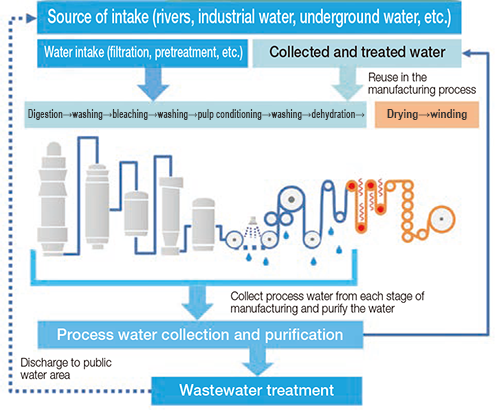
Across the Group, we work to make effective use of water resources toward the targets of reducing water withdrawal intensity by 6% or more by FY2030 (compared to FY2018) and reducing total water withdrawal by 10% or more by FY2040 (compared to FY2018). All business sites of the Group have formulated water management plans and manage water withdrawal and wastewater discharge. For example, at paper and paperboard manufacturing mills, water used in each process -- pulp cooking, washing, bleaching, stock preparation and papermaking -- is collected, treated, purified and reused. In addition, water is recovered from the steam used in the paper drying process and reused, thereby reducing water usage.
Continuous improvement towards the FY2030 target
In FY2025, the Oji Group's total water withdrawal was 663 million m³, total wastewater discharge was 636 million m³, and water consumption was 27 million m³. The Group works to make effective use of water resources toward the target of reducing water withdrawal intensity by 6% or more by FY2030. In particular, Oji Paper, Oji Materia, Oji F-tex and Oji Nepia, which together account for approximately 80% of the Group's total water withdrawal, have formulated and are implementing specific reduction plans through 2030. Performance data of the four companies are collected on a quarterly basis, and progress toward the targets is evaluated. Progress is reported once a year to the directors at the Sustainability Committee, and continuous improvements are implemented.
Examples of Water Reduction Initiatives
Each company within the Oji Group refers to the AQUEDUCT evaluation and implements initiatives to reduce water usage and to mitigate water-related risks. Examples of each company's initiatives, together with the corresponding evaluation results, are introduced below.
- * Water reduction initiatives at business sites located in areas of high water stress (Extremely High or High) are described in the previous section.
Jiangsu Oji Paper (China): Medium to High
Jiangsu Oji Paper has significantly reduced water consumption by implementing the best available technology recommended by the European Commission for environmental protection purposes in its paper and pulp production activities.
Oji Materia Osaka Mill (Japan): Low to Medium
Oji Materia Osaka Mill has adopted and implemented the following techniques, which are among the best available techniques recommended by the European Commission. This has resulted in significant water reduction effects, making it possible to reduce water intensity (m3/ton), which represents the amount of water used (m3) relative to the amount of paperboard produced (in tons), to single digits. We are proud to be industry leaders in terms of water usage efficiency.
6.3.2 Separation of sealing and cooling water from contaminated process water and water reuse
6.3.3 Optimal water management, water loop separation and arrangement, counter-current flows and internal water clarification
6.3.5 Removal of calcium from process waters
6.3.6 Installation of an equalization basin and primary treatment of waste water
6.3.11 Clarification of white water (water containing fine fibers)
6.3.12 Prevention and elimination of biofilms by using methods that minimize emissions of biocides
6.3.13 Effective reject and sludge handling and processing (dewatering) on site
For more technical information, see the Best Available Techniques (BAT) Reference Document for the Production of Pulp, Paper and Board (europa.eu)
CENIBRA (Brazil): Low
CENIBRA is recovering cooling water to more effectively use it. Additionally, CENIBRA will invest in equipment to increase heat recovery efficiency in the future as part of the plant modernization project. By optimizing the use of steam, it is expected that water consumption will be further reduced.
Examples of Effective Water Use Initiatives
Jiangsu Oji Paper (China)
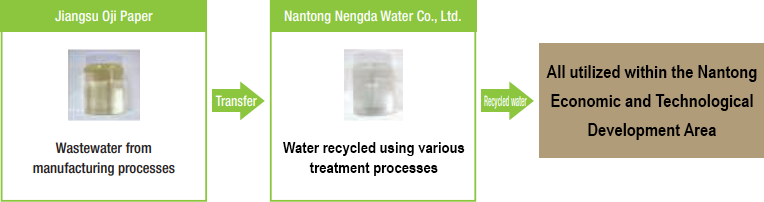
Wastewater generated by Jiangsu Oji Paper in its manufacturing processes is treated and purified until it meets the regulatory standards for wastewater, and then it is transferred to Nantong Nengda Water Co., Ltd. in the Nantong Economic and Technological Development Area. After undergoing various treatment processes, this water is all used as recycled water within the Economic and Technological Development Area.
Recycled water is water of a quality between tap water and sewage that is used for industrial purposes.
Prevention and Mitigation of Regional Impact through Wastewater Treatment
When water used in business operations is returned to the local environment, wastewater needs to be treated in order to prevent and mitigate negative impacts. The Oji Group treats wastewater at its wastewater treatment facilities and discharges it into rivers, seas or the treatment facilities of third parties at levels below its own voluntary control values, which are stricter than the applicable legal regulatory limits. For specific initiatives, please refer to the link below.
Engaging with Water-Related Stakeholders (Outside Areas of High Water Stress)
Water resources are a resource shared with the local community, and production sites engage in dialogue with local stakeholders on matters such as water use, water conservation and the conservation of water resources. In areas of high water stress, the Group is working toward the target of conducting stakeholder engagement at least once per year. Examples of stakeholder engagement at sites located outside areas of high water stress are introduced below.
CENIBRA (Brazil)
CENIBRA, Brazil: As a representative of the private sector, CENIBRA participates in local river basin committees and forest dialogue councils, contributing to the development of the forest sector and strategies for the conservation of water resources, natural resources and biodiversity.
CENIBRA's eucalyptus plantations and pulp production use water from the region’s Doce River Basin. In recent years, there has been less rainfall than usual, and the risk of a water shortage has been a concern for the entire region. To address this issue, CENIBRA has regularly monitored water at each water point to identify the sub-basins of greatest influence. In collaboration with government authorities and local residents, CENIBRA is focusing on water conservation activities for these sub-basins to improve their practices regarding access to water and sanitation. Specifically, CENIBRA is working on the following initiatives:
Building water reservoirs in the forest
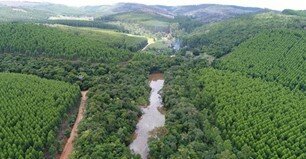
Since 2018, CENIBRA has built 100 reservoirs in its forests, storing a total of more than 1 million m3 of water, allowing excess water during the rainy season to slowly percolate into the soil, later into the river, maintaining the level of the water table in the basins. When determining the locations of these reservoirs, the residential-use water supply was considered, increasing harmony with the local community regarding the use of water resources.
Subsoiling
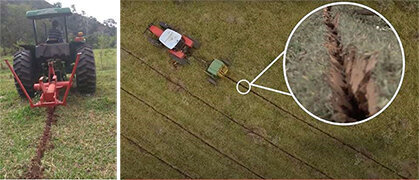
In recent years CENIBRA has developed subsoiling activities prior to planting seedlings to improve the regular infiltration of rainwater into the soil which is compacted by the activity of heavy machinery in its forests. Now CENIBRA is sharing this technique and its expertise with its neighbors, including log suppliers and farmers, who are contributing to the recovery of underground water retention in compacted pasture lands, as well as the prevention of erosion resulting in better water quality in the basin.
Click here for the video.
Water Source Protection Project
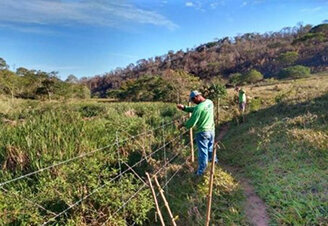
Within the scope of the Spring Protection Project, CENIBRA has played a crucial role in the preservation of springs located on third-party lands, especially those used for livestock and related activities. These areas, recognized as Permanent Preservation Areas under the Brazilian Forest Code, require landowners to ensure the preservation of native vegetation within them. However, many rural producers in the region were unaware of proper protection methods or faced economic constraints, resulting in inadequate conservation practices.
In this context, CENIBRA took the initiative to identify the basin of a Rio Doce tributary as a priority area for water source protection, facilitating actions that encourage producers to protect springs. This included providing materials, using technologies and installing protective fences. The delineation of these areas prevents livestock which previously had free access from entering them, preventing water source contamination and enabling the natural regeneration of vegetation.
Between 2017 and 2023, over 1,300 hectares of Permanent Preservation Areas, including all of the springs supplying the municipality of Peçanha, were effectively protected. In addition to the positive environmental impact, this project also significantly contributed to increasing landowners’ awareness of the importance of water resources and biodiversity conservation. This partnership between CENIBRA, the municipality of Peçanha and the local community strengthens relationships and facilitates cooperative engagement for sustainability and collective well-being.
For more information about CENIBRA’s initiatives in the past, click here.
Oji Paper (Japan)
The Oji Paper Tomioka Mill and Yonago Mill participate in the Naka River South Bank Land Improvement District Water Use Association, etc. and the Hino River Basin Water Use Council, respectively. They are working to reduce water intake in accordance with dam storage rates to prioritize the local agricultural use of water during summer water shortages.
Oji F-Tex (Japan)
The Oji F-Tex Shibakawa Mill has signed a memorandum of understanding regarding water use with the local fisheries cooperative and cooperates in the protection of the local environment and aquatic life.